
SEO isn’t dead. Google ranks pages; AI engines cite passages and name brands. Having been in the industry for 12 years, I have seen the shift first-hand. The day ChatGPT invited users to test their application, 30 November 2022, was the start of the AI SEO era.
What still works are the underlying fundamentals of SEO: technically sound, crawlable pages with clean, accessible, well-structured HTML help both users and search systems understand the content. But content is no longer the only visibility factor. A clear, credible brand presence matters too. Having a strong, consistently communicated brand position can be an important differentiator.
What hasn’t changed: SEO is still the foundation
AI chatbots still need a search index to find current information. When AI chatbots answer questions about current products and local businesses, they usually search a web index first. Which index they use changes; the need for one doesn’t. If your site isn’t crawlable and indexed, it can’t be found, so may be less likely to be retrieved or cited. Being on various search engines is still the foundation. So indexing, crawlability, quality content and links still feed AI answers. AI SEO isn’t a replacement for SEO. It’s a layer on top.
Learn what GEO and AEO mean for your business.
Google ranks pages, AI recommends brands
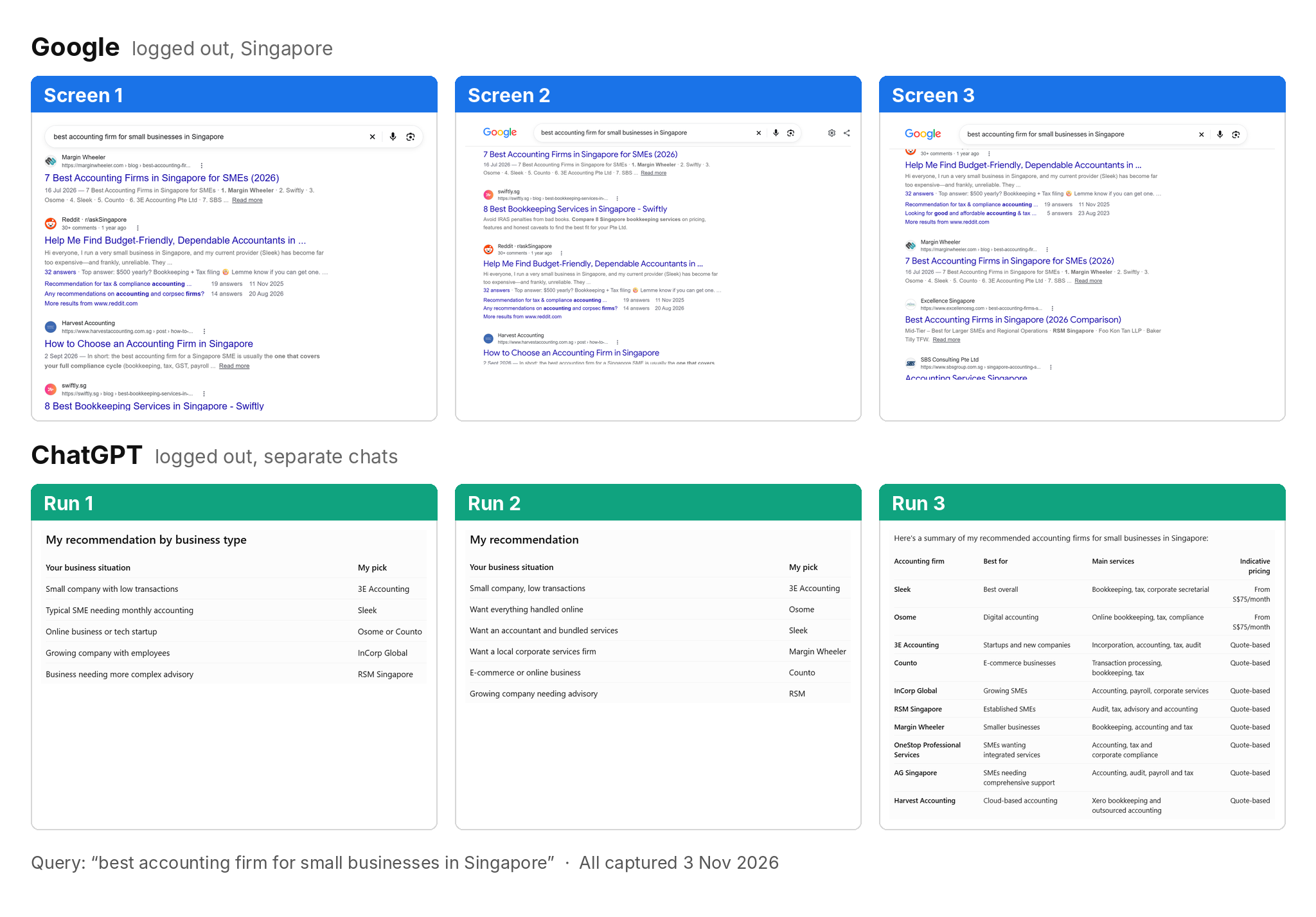
Google ranks pages written by individual firms. ChatGPT names the brands those pages repeat. Five firms were named in all 3 runs; two firms whose own pages rank on Google were never named.
| Business | How it appears on Google (3 result screens) | ChatGPT run 1 | ChatGPT run 2 | ChatGPT run 3 |
| Osome | Named #3 in Margin Wheeler’s list | Yes | Yes | Yes |
| Sleek | Named #4 in Margin Wheeler’s list; criticised in a ranking Reddit post | Yes | Yes | Yes |
| 3E Accounting | Named #6 in Margin Wheeler’s list | Yes | Yes | Yes |
| Counto | Named #5 in Margin Wheeler’s list | Yes | Yes | Yes |
| RSM Singapore | Named in Excellence Singapore’s list (1 of 3 screens) | Yes | Yes | Yes |
| Margin Wheeler | Own list ranks on all 3 screens, and ranks itself #1 | No | Yes | Yes |
| InCorp Global | Not seen in these results | Yes | No | Yes |
| Harvest Accounting | Own guide ranks (2 of 3 screens) | No | No | Yes |
| OneStop Professional Services | Not seen in these results | No | No | Yes |
| AG Singapore | Not seen in these results | No | No | Yes |
| Swiftly | Own page ranks (2 of 3 screens); #2 in Margin Wheeler’s list | No | No | No |
| SBS Consulting | Own page ranks (1 of 3 screens); #7 in Margin Wheeler’s list | No | No | No |
| Foo Kon Tan, Baker Tilly TFW | Named in Excellence Singapore’s list | No | No | No |
- A steady core: Osome, Sleek, 3E Accounting, Counto and RSM Singapore were named in all 3 runs. All five appear in at least one of the 5 “best accounting firm” lists that rank on Google.
- A rotating tail: run 3 named 10 firms against 6 in runs 1 and 2. The extra names change from run to run; the core does not.
- Ranking your own page is not enough: Swiftly and SBS rank on Google but were never named. Harvest Accounting ranks and was named once in 3 runs.
- In this small test, brands with more visible third-party coverage and branded search demand were more consistently named. This suggests—but does not prove—that off-site brand evidence influences AI recommendations.
| SEO Components | What gets your page ranked (Google) | What gets your brand recommended (AI) |
| On-page | Keyword and topic match, titles, headings, comprehensive content | A clear one-line description of what you do and who you serve, repeated on every key page |
| Off-page | Backlinks, domain reputation | Being named in other sites’ “best X” lists, reviews, Reddit and Quora threads, and directories |
| Technical | Crawlability, indexing, Core Web Vitals | AI crawlers allowed, key content in the HTML, Organization and Person schema with sameAs links |
| Measured by | Position, CTR, traffic | How often AI names you, and how it describes you |
Brand strength of the firms in the test
The two firms ChatGPT never named, Swiftly and SBS, had the lowest branded search volume. Every firm named in all 3 runs had at least 110 searches a month.
| Brands | ChatGPT runs naming it (of 3) | Branded search volume (Singapore) | Google rating and reviews | “Best accounting firm” lists naming them |
| RSM Singapore | 3 | 2,900 | 2.7 stars, 20 reviews | 2 out of 5 |
| Osome | 3 | 2,400 | 4.2 stars, 1,117 reviews | 2 out of 5 |
| 3E Accounting | 3 | 390 | 4.7 stars, 90 reviews | 3 out of 5 |
| Counto | 3 | 210 | 4.7 stars, 98 reviews | 1 out of 5 |
| Sleek Accounting | 3 | 110 | 4.5 stars, 1.3k reviews | 2 out of 5 |
| Margin Wheeler | 2 | 480 | 4.9 stars, 481 reviews | 1 out of 5 |
| Harvest Accounting | 1 | 70 | 5 stars, 48 reviews | 0 out of 5 |
| SBS Consulting | 0 | 40 | 4.1 stars, 10 reviews | 1 out of 5 |
| Swiftly SG | 0 | 30 | 4.8 stars, 132 reviews | 1 out of 5 |
Source: Harvest SEO data, collected 5 Nov 2026. Sleek and Swiftly are common words, so their volumes use “sleek accounting” and “swiftly sg”.
| “Best accounting firm” lists on Google | Publisher | Ranks itself first? |
| Best Accounting Firms in Singapore (2026 Comparison) | Excellence Singapore, an accounting firm | Yes |
| 7 Best Accounting Firms in Singapore for SMEs (2026) | Margin Wheeler, an accounting firm | Yes |
| A List of Top Audit Firms in Singapore | Paul Wan & Co, an audit firm | No |
| 6 Best Accounting Services in Singapore in 2026 | Statrys, a corporate services firm | Yes |
| Best accounting firms in Singapore (2026) | FYAdvisers, a matching service paid by providers | No |
Mentions vs citations: two different wins
A mention means an AI chatbot names your brand in its answer. This is driven by brand evidence across the web. A citation means an AI chatbot links your page as a source. This is driven by clear, quotable content. Mentions bring leads, while citations build authority. You need both to build your business.
Why AI keeps recommending the same big brands
An AI chatbot recommends what it has the most evidence for. In my test, that evidence pointed to the same five names every time. There are three likely reasons.
1. It repeats what it has read most often
ChatGPT learnt about brands from a huge amount of text on the web. A brand that appears in thousands of articles, reviews and forum threads leaves a stronger pattern than one that appears in a few dozen. Osome has 2,400 branded searches a month and over 1,100 Google reviews, so there is far more written about it than about a firm with 30 searches.
2. When it searches, it reads the same lists you do
For questions about local businesses, ChatGPT often searches the web before answering. The pages it finds for “best accounting firm” are mostly “best of” lists, and four of the five lists in my test were written by accounting firms that ranked themselves first. A brand that appears across several of these lists looks like a safe answer. A brand that appears on only its own website does not.
ChatGPT also named InCorp, OneStop and AG Singapore, which never appeared in my Google results. Its search draws on more than Google’s first pages, so being mentioned across the wider web matters, not just on page one.
3. A well-known name is the low-risk answer
From the chatbot’s side, recommending a firm many people have heard of is unlikely to be wrong. Naming a small firm with thin evidence is riskier. That is why star ratings alone didn’t decide the result. RSM Singapore was named in all 3 runs with 2.7 stars from 20 reviews. Swiftly was never named despite 4.8 stars from 132 reviews. Volume of evidence beat quality of reviews.
Researchers call this pattern popularity bias. It is a well-documented problem in recommender systems, where popular items get recommended more and so become even more popular. A 2024 study, “Global is Good, Local is Bad?”, found a related bias in large language models: they tend to favour global brands over local ones. My test shows the same pull towards size. The winners were mostly Singapore brands, but they were the biggest and most talked-about ones.
Source: https://arxiv.org/abs/2406.13997
The differentiator: own one brand position
A small firm can’t out-search Osome or out-review Sleek, and it doesn’t need to. Popularity bias works by category: AI looks for the safest answer to each question. “Best accounting firm in Singapore” will go to the big names. “Best accountant for F&B start-ups in Singapore” is a smaller question with less evidence to weigh, and a firm that is described the same way across many sites can become the safest answer to it.
You can’t be the safest name in everything. Be the safest name in one thing. Own your niche in your industry.
What you can do is to write a one-line position and repeat it on your website, social media pages, online directories and schema. Say it word for word so that AI chatbots can safely describe your position, as the same brand position is found everywhere on the web. Earn one outside source a month that repeats it. Over time, future training data and live search results will reflect it, and AI chatbots will remember what your brand stands for.
Not sure what your one-line position should be? Let’s check how AI describes your business today and find the line you should own. Connect with Harvest SEO at +65 8101 2023.
Want to know where your business stands? A free audit shows whether ChatGPT, Perplexity and Gemini name you — or your competitors — and what to fix first.
Find out if your business is keeping up — get an auditTL;DR
- Google ranks pages, while AI chatbots such as ChatGPT cite passages and recommend brands.
- AI chatbots usually search a web index for current information, so a website that is not crawlable and indexed cannot be recommended by AI.
- In a Harvest SEO test of "best accounting firm for small businesses in Singapore" (3 Nov 2026), ChatGPT named Osome, Sleek, 3E Accounting, Counto and RSM Singapore in all 3 runs.
- Swiftly and SBS Consulting had their own pages ranking on Google, but ChatGPT never named either firm in 3 runs.
- Every accounting firm that ChatGPT named in all 3 runs had at least 110 branded searches a month in Singapore (Harvest SEO data, Nov 2026).
Common questions
Is SEO dead because of AI?
No. SEO is still the foundation of AI search. AI chatbots such as ChatGPT usually search a web index before answering questions about current products and local businesses. If a website is not crawlable and indexed, AI chatbots cannot find it or recommend it.
What is the difference between AI SEO and traditional SEO?
Traditional SEO gets a page ranked on Google through keywords, backlinks, crawlability and Core Web Vitals, and is measured by position, CTR and traffic. AI SEO gets a brand recommended by AI chatbots through consistent brand descriptions, third-party mentions, AI-crawler access and schema, and is measured by how often AI names the brand.
Does ranking on Google mean ChatGPT will recommend my business?
No. In a Harvest SEO test of "best accounting firm for small businesses in Singapore", Swiftly and SBS Consulting had their own pages ranking on Google but were never named by ChatGPT in 3 runs. ChatGPT named the brands that other websites' "best of" lists repeated.
What is the difference between a mention and a citation in AI search?
A mention is when an AI chatbot names a brand in its answer, driven by brand evidence across the web. A citation is when an AI chatbot links a page as a source, driven by clear, quotable content. Mentions bring leads; citations build authority.
Why does ChatGPT keep recommending the same big brands?
AI chatbots recommend the brands they have the most evidence for, a pattern known as popularity bias. A 2024 study, "Global is Good, Local is Bad?", found that large language models favour global brands over local ones.
How can a small business get recommended by AI chatbots?
A small business should own one brand position. Write a one-line description of what the business does and who it serves, and repeat it word for word on the website, social media, directories and schema. Then earn one outside source a month that repeats the same line.